First-time visitors to Beijing can rarely resist the Great Wall.
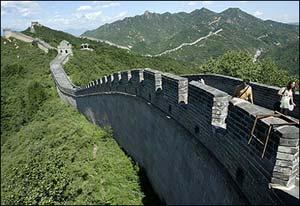
And more often than not, they visit the Badaling section. The
reason is obvious: Badaling, the first section of the Great Wall to
open to tourists, is closest to the city.
As a top tourist destination, the 7,600-meter-long Badaling
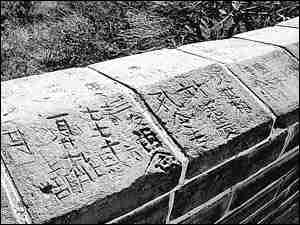
section of the Great Wall has borne the brunt of vandalism and
erosion, with recent media reports highlighting damage caused by
vehicle exhaust, name-carving and litter. The 2,000-year-old solemn
serenity is also disrupted by the constant noise of nearby motor
vehicles, holiday resorts and amusement facilities.
The news broke on April 15 that the city government's Badaling
Special Zone Administration had seized the right to manage Badaling
from its former partners citing new legal regulations in its
support.
With the new agreement, the Badaling Special Zone
Administration, an accredited representative of local government,
will now be solely responsible for all tourism and conservation at
Badaling.
"The regulatory job becomes a unified operation. And the
responsibility is clear," said Li Shuwang, deputy director of
Badaling Special Zone Administration.
Li outlined the new work ahead:
Tree planting and planning for commercial ventures near and on
the wall;
Setting up consistent signs near the wall;
Repair and consolidation of the unopened parts of the Great Wall
under its care;
And, upgrading the display and exhibits at the Great Wall
Museum.
"We shall carry out the regulatory work with conservation at the
core. Tourism will be developed on the basis of conservation.
Revenues will no longer be the chief objective," said Li.
The first indicator of potential change at Badaling came in
2002, when China revised its Law on Protection of Cultural Relics.
Then in 2003, Beijing introduced the Administrative Regulations on
Protection of the Great Wall.
The 2002 State Law rules that the right and responsibility of
caring for the country's cultural relics rests with governmental
cultural relics regulatory institutions. But in reality, government
organs like gardening, tourism and state-owned companies often
share the rights, if not the responsibility.
For a cultural relic, the Great Wall is unique in its size and
complexity. Walls meander thousands of miles, passing through a
handful of provinces and more than 200 counties of North China. A
large portion of the Great Wall is located in poor, remote areas
where few people reside. Just how long is the wall? Nobody knows
for sure. The traditional estimate is 50,000 li, or 25,000
kilometers. The main leftovers of the Great Wall were rebuilt in
the Ming (1368-1644) and Qing (1644-1911) dynasties. Together, they
measure about 6,700 kilometers. Until now, no official survey has
been conducted to find out the exact length. The government plans
to use remote sensors and other sophisticated technologies to
measure the length in the near future, said He Shuzhong, deputy
head of the Policy and Regulation Division at the State Cultural
Relics Bureau in the Ministry of Culture.
"The great value of the Great Wall is its great size of
10-thousand plus li," said Dong Yaohui. Dong ought to know: He
walked the entire length of the Wall, west-east, between 1984 and
1985. He's probably the first known Great Wall-walker since the
founding of modern China. From his own experience, Dong said about
one third of the Wall remained in reasonable shape, another third
was in ruins, and the rest was gone forever.
The conditions of the different sections of the Great Wall vary
as does the standard for its conservation, said He Shuzhong. He
argues that the unique complexity of the Wall merits a special law
dedicated to its preservation. Local regulations are of limited
effectiveness. National regulations were submitted at the end of
2004 for approval by the State Council, which promised to deal with
the issue as a priority for this year. The regulations are likely
to be released this coming summer, He believed.
"The law alone is certainly not enough," he said. "but (when
problems arise in the future) at least you will have a law to turn
to."
The new Law on Protection of Cultural Relics clearly states that
all ticket income should be used for preservation. The Badaling
Special Zone Administration has pledged to do this. But this
situation differs from other sections of the Wall, according to He.
Ticket revenue in other sections is often used to pay for anything
but conservation.
"Government funding for Great Wall conservation has increased in
recent years," said He Shuzhong. "But overall, there are still too
many debts. "
Funding was not the biggest problem, said Dong Yaohui. The most
important issue was awareness. The government and the general
public need to realize the importance and urgency of protecting the
Great Wall.
The task has much to do with national pride and patriotism. "The
Great Wall has great historical value, and it is endangered, dying
out," Dong said.
The China Great Wall Society, a Chinese non-government
organization that champions restoration of the Great Wall, has
organized a 35-day tour for journalists starting at the end of
April. They reported on the state of Wall sections from Shanhaiguan
in the east end to Jiayuguan in the west.
A clear definition and assignment of responsibilities was also
important, said Dong. Many Great Wall sections mark the border
between provinces, counties, towns and villages. The result is many
sections have become neglected.
The China Great Wall Society is pushing for an adopt-a-wall
scheme with tablets erected every kilometer citing who is
responsible for each section of the Ming wall. In remote areas,
said Dong, peasants might be mobilized to perform guard duty.
Companies had already expressed an interest in sponsorship, he
said.
Preservation means nothing without accountability, said Dong. He
urged failing officials to be punished. Take the case of a road
construction company from outside Baotou, Inner Mongolia. To make
room for its 96 million yuan (about 10 million dollars) new
highway, the company demolished a section of the Zhao Great Wall
built in the Warring States (475-221 BC). The company was fined
80,000 yuan (about 10,000 US dollars) in 1999. "Such a joke-like,
meager fine is in effect a green light for demolition," he said. Or
in October 2004 when part of the Pingyao ancient city wall
collapsed, local officials blamed it on the poor quality of the
400-year-old architecture. Nobody was ever held accountable.
Law enforcement must be intensified, agreed He Shuzhong. That
means making conservation of the Great Wall part of a government
official's assessment, ranked on his official record. Government
departments like human resources and discipline supervision should
get in on the act, He said.
Greater publicity is needed to educate people, helping them
understand the great value of the Great Wall and the severe,
irrecoverable damage inflicted upon it by humans, said Dong Yaohui.
He depicts the damage as coming in two waves of destruction since
the founding of New China in 1949: The first wave hit between the
1950s and 1980s, when governments throughout China encouraged and
even organized the dismantling of the Wall. Since then, he
suggested, destruction has been largely nongovernmental.
Dong Yaohui recalled from a recent survey he had conducted that
one farmer pointed at the Great Wall and asked, "What's the use of
this stuff?" Dong suspects that in some underdeveloped rural
regions, peasants continue to pilfer bricks from the Wall to build
roads, houses and pigsties. One section of the Great Wall in
Wanquan county, Zhangjiakou had been converted into a 1,000-plus
meter ditch before local media attention ended the digging. Amateur
renovation often does more harm than good. And "restored" Great
Wall gleams, like the infamous section at Bai Yangyu in Hebei
Province. "Just short of putting a porcelain coat on it," Dong
said.
"Too often people see only the exploitable value of the Great
Wall and not its historical value," said Dong. The rare cases where
the Wall has been well-preserved, he said, came about either
because it was in a remote, treacherous area or because that
particular section was associated with mystic tales of
revenge-seeking demons.
Dong Yaohui has been with China Great Wall Society since its
inauguration in June 1987. First as secretary general, now
executive vice president, he has spent almost two decades calling
for Great Wall preservation.
While much of his publicity efforts focus on promoting ethical
conduct among tourists, Dong said he believed many amateur graffiti
artists were well aware of their wrongdoing. On Badaling Great
Wall, most graffiti is in Chinese, but there are occasional notes
in Indian, Japanese and Korean. And the messages themselves suggest
that many of the vandals are university students, professors
even.
In a country where many much more serious illegal acts go
unpunished, the deterrence value of any law seeking to punish
vandals is inevitably compromised, said one observer, who declined
to be identified.
The vandals and the conservationists form only tiny minorities,
said Dong. When it comes to the Great Wall, the vast majority of
the population remains indifferent. Most people witnessing carving
take it for granted, he said, and the media did not consider it an
issue. Dong called on people who laud the Great Wall as the symbol
of Chinese pride to honor their grandiose statements and
sentiments.
Last year, the Society sponsored a hotline soliciting
suggestions for repairing the damage to the wall caused by
name-carving. Hundreds of proposals were collected, but none
considered feasible. "The damage was irreparable and we already
knew that in advance," said Dong. "The real purpose of the event
was to call public attention to the issue."
Starting from the main entrance, walking either north or south
of the Badaling Great Wall, almost every brick has been scratched
by a knife, key, pointed stone or hairpin. Carving decreased after
1997, according to the Society. This might have been due to
enhanced public awareness, or simply because there was no
accessible space left for vandals to bring their artistic instincts
into play.
Among the suggestions collected via hotline last year was a
proposal for furnishing special brick or wood plaques on the Wall
for tourists to do their own paid carving. In this way, the adviser
said, people had a vandalism-free opportunity to express their
pride of conquering the Great Wall and becoming "a hero".
The Great Wall was listed by UNESCO as a World Cultural Heritage
site in 1987. It was later placed on the World Monuments Fund list
of the World's 100 Most Endangered Sites.
"Just as the world does not belong only to human beings, the
Great Wall does not belong only to China," said William Lindsey, a
passionate promoter of Great Wall conservation efforts ever since
he walked the entire length of the Wall 1986-87. Lindsey now heads
the International Friends of the Great Wall, an NGO dedicated to
its conservation.
Speaking at a press conference in July 2002 for the signing of a
cooperative memorandum between Beijing government and the
International Friends, Kong Fanshi, deputy director of Beijing
Cultural Relics Bureau, said they recognized that preservation of
the Great Wall did not merely mean repairing. He said the Bureau
would also try prevent human damage, prevent the invasion of
modernism and to preserve the environment around the Wall.
"The prospects are bright, " said Dong Yaohui. "Growing media
reports of Great Wall problems are not the result of increasing
damage, but a reflection of growing public concern and enhanced
awareness. This will help solve the problem of conservation and
exploitation."
A recent public appraisal by 31 Chinese newspapers produced a
list of 50 tourist places worth visiting most by foreign tourists.
The number one spot was the Badaling Great Wall.
(Xinhua News Agency June 6, 2006)